
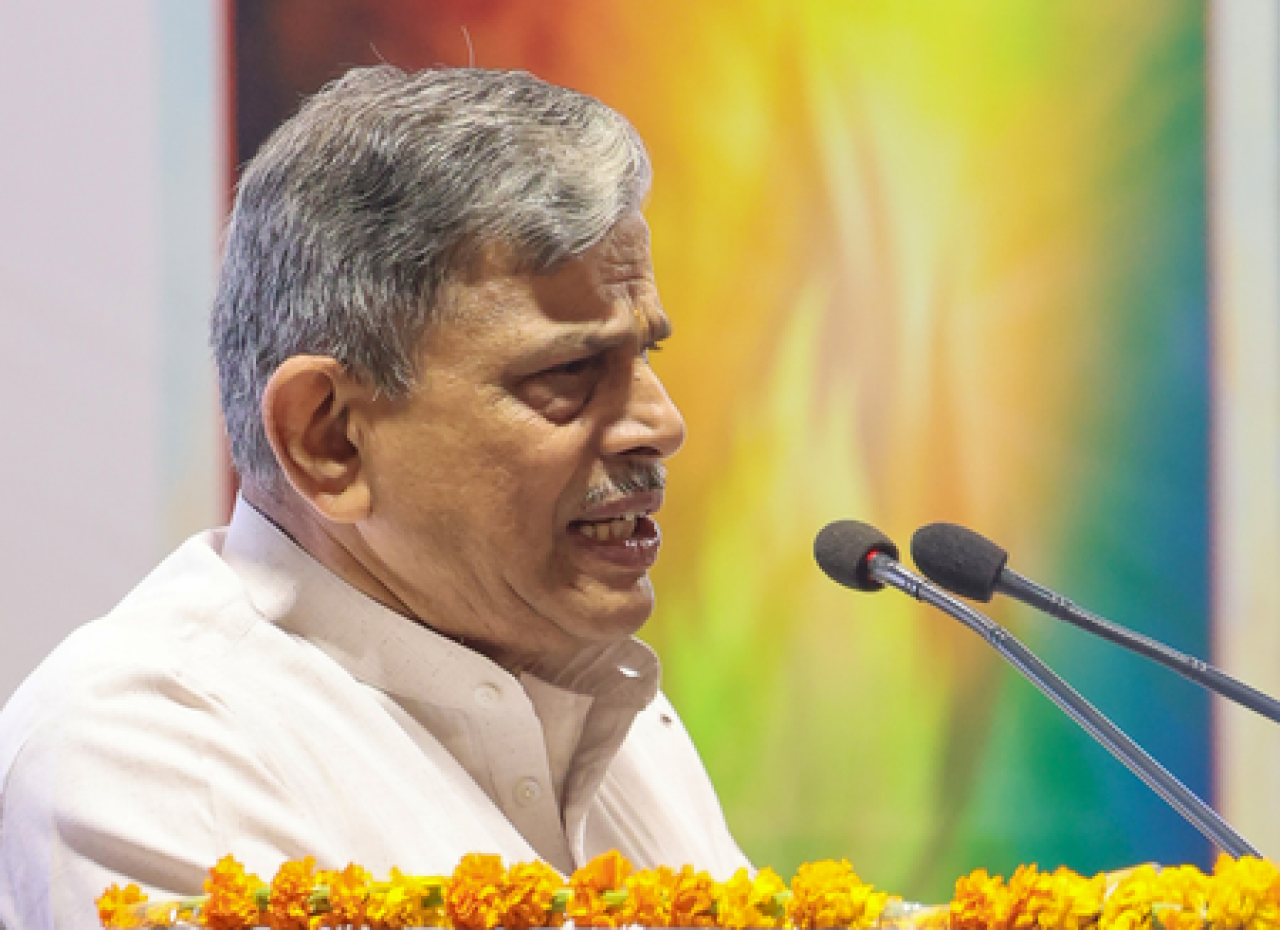
Stanford, April 18: The Rashtriya Swayamsevak Sangh (RSS) has articulated a clear perspective on the Indian diaspora. Dattatreya Hosabale, the organization’s General Secretary, emphasized that Indians living abroad should prioritize their loyalty to the countries they reside in while also maintaining their cultural roots.
In an interview marking the centenary of the RSS, Hosabale explained that the organization’s activities overseas are based on two main principles: integrating into local societies and preserving cultural ties with India.
He stated, “Volunteers living in various countries strive to organize the Hindu community there. However, their work extends beyond the community; they also contribute to the broader society.”
Hosabale clarified that the primary responsibility of migrants should be towards their host countries. He remarked, “Loyalty and commitment to the nation they reside in, along with contributing to its development, should be the foremost priority.”
This mindset ensures that Indian expatriates become responsible citizens in their adopted countries while also retaining their cultural identity. Their cultural connections allow them to stay linked to India and serve it from afar.
He connected this idea to the principle of ‘Vasudhaiva Kutumbakam,’ meaning ‘the whole world is one family,’ stating that it is a core aspect of RSS philosophy. This concept is not merely a slogan but is actively practiced.
According to him, this philosophy inspires individuals to view the world as a family, reducing conflicts and fostering cooperation. He also referenced India’s recent global message of ‘One Earth, One Family, One Future,’ which reflects this cultural thinking.
Discussing global challenges, Hosabale pointed out that the world is currently facing several serious issues. He identified power politics, violence in the name of religion, and environmental crises as major concerns.
He warned that religious extremism remains a significant threat to humanity. Violence committed in the name of religion poses risks to society.
Hosabale stated, “If families are strong, societies will be strong, and consequently, nations will be strong.” He described ‘love and affection’ as the foundation of a healthy society.
He noted that these issues are interconnected and can only be resolved based on cultural and moral values. Hosabale emphasized, “Diversity exists, but it is essential to practice universal unity.”
On environmental issues, he highlighted the need for balance, asserting that while scientific and technological advancements are necessary, they should not come at the cost of environmental sustainability.
Discussing the role of RSS, Hosabale stated that the organization works towards building ‘human social capital,’ which includes both cultural values and organizational discipline.
He described the RSS as an organization, a movement, and a way of life. Hosabale indicated that this model could be adopted in various parts of the world.
However, he clarified that the RSS does not attempt to impose its framework in other countries but emphasizes adopting principles according to local circumstances. The goal is for these values to contribute to the development of societies in every nation.
Hosabale also sought to dispel misconceptions regarding the RSS’s international role, asserting that the organization does not aim to influence any country’s national identity or political system.
Speaking on interfaith relations, he urged religious leaders to move beyond narrow thinking and embrace broader principles of spirituality. Hosabale remarked, “Religion and spirituality are distinct. Spirituality transcends religion.”
He noted that every religion has its civilizational roots, and understanding these can enhance unity among humanity. Recognizing civilizational roots can facilitate human unity.
In the context of India, he stated that everyone has the freedom to practice their religion, but loyalty to the nation is equally essential. While individuals should have the freedom of belief, allegiance to the nation is crucial.
This statement comes at a time when people of Indian origin are increasingly playing influential roles in politics, business, and education in the United States, the United Kingdom, and Gulf countries.

Leave a Comment