
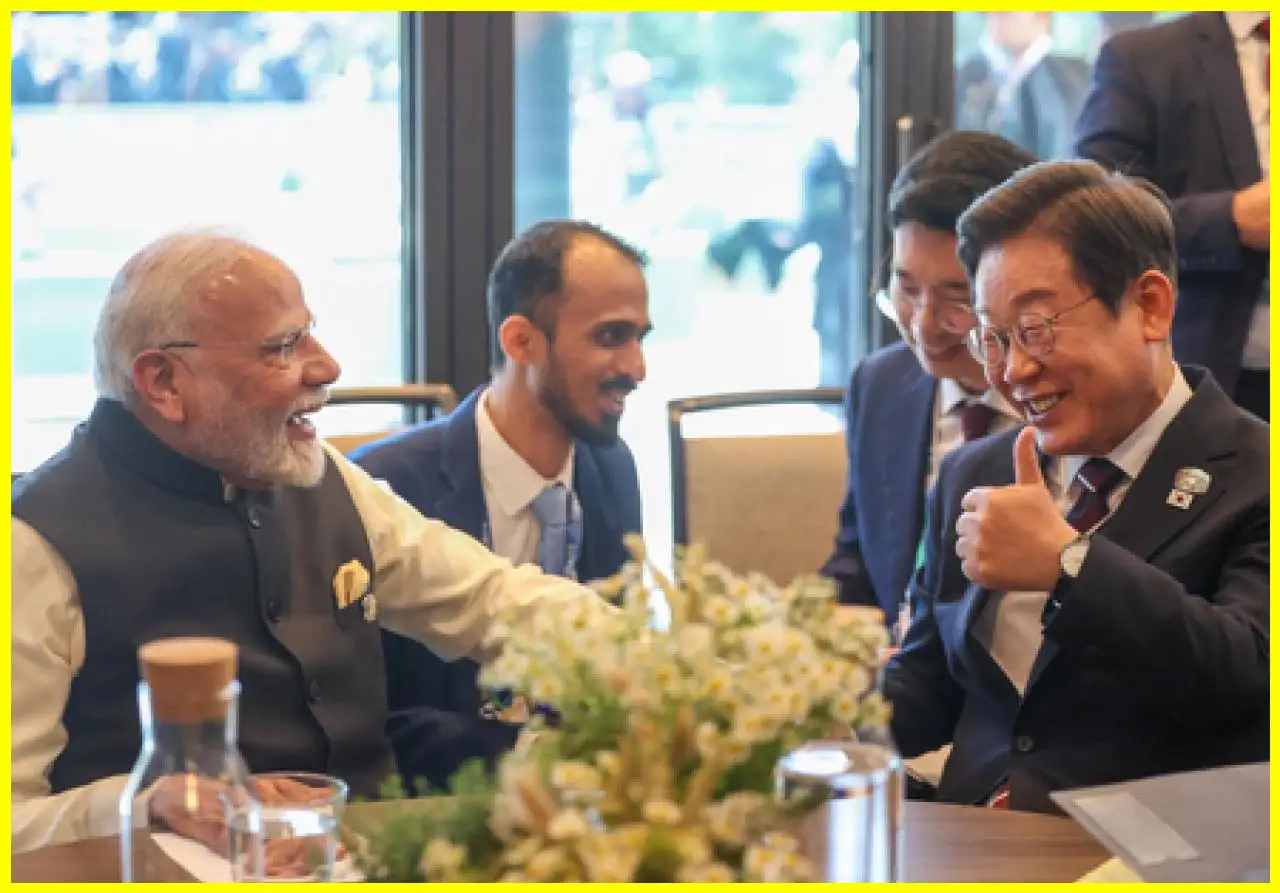
Seoul, April 19: South Korean President Lee Jae-myung is set to visit India, where he will participate in a summit with Prime Minister Narendra Modi. Kyunghoon Kim, head of the India and South Asia team at the Korea Institute for International Economic Policy (KIET), highlighted how India and South Korea have deepened their engagement over the last ten months.
Kyunghoon Kim shared on the social media platform X, “Continuous dialogue is essential for building connections, aligning ideas, and ultimately shaping the agenda before the summit. Let’s explore how Korean and Indian officials have been doing just that over the past ten months. President Lee Jae-myung and Prime Minister Modi met during the G7 (June 2025) and G20 (November 2025) summits.”
He added, “In the past eight months, South Korean Foreign Minister Choi Hyun and Indian External Affairs Minister Dr. S. Jaishankar have met three times in Delhi, Kuala Lumpur, and Yvelines amidst their busy schedules. The South Korean Foreign Minister, who previously served as an ambassador in India, is expected to play a crucial role in strengthening these relations.”
Kyunghoon Kim noted that industrial collaboration between the two countries has also increased. India’s Minister of Petroleum and Natural Gas, Hardeep Singh Puri, visited South Korea in November 2025 to discuss shipbuilding, while South Korea’s Minister of Science and ICT visited India in February 2026 to discuss AI. Additionally, trade ministers met in March 2026.
Looking ahead, soft power initiatives are also in focus. In January 2026, the Education Minister opened a Korean Education Center in Delhi to support Koreans living abroad and enhance educational cooperation. This center aims to promote Korean language education and attract Indian students.
He mentioned that regular systems will continue, with the South Korean Foreign Ministry and India’s Ministry of External Affairs playing significant roles. For instance, the sixth Korea-India Foreign Policy and Security Dialogue took place in February 2026, followed by the third consular consultation in April 2026. Continuous dialogue is crucial, especially during challenging times. Think tanks associated with the government, such as the Korea National Diplomatic Academy, KIET, the Indian Council of World Affairs, and the RIS think tank, have also contributed. Experts came together for the third 2+2 think tank dialogue in April 2026 to assess current partnerships and explore areas for collaboration.
He concluded, “The South Korean embassy in India and the Indian embassy in South Korea, along with ambassadors Lee Seong-ho and Gouranglal Das, have been vital mediators throughout this period. Compiling a list of all their efforts over the past ten months would be akin to writing a book. A salute to everyone working behind the scenes before the summit. While a little rest may be necessary, it will soon be time to turn results into action.”

Leave a Comment