
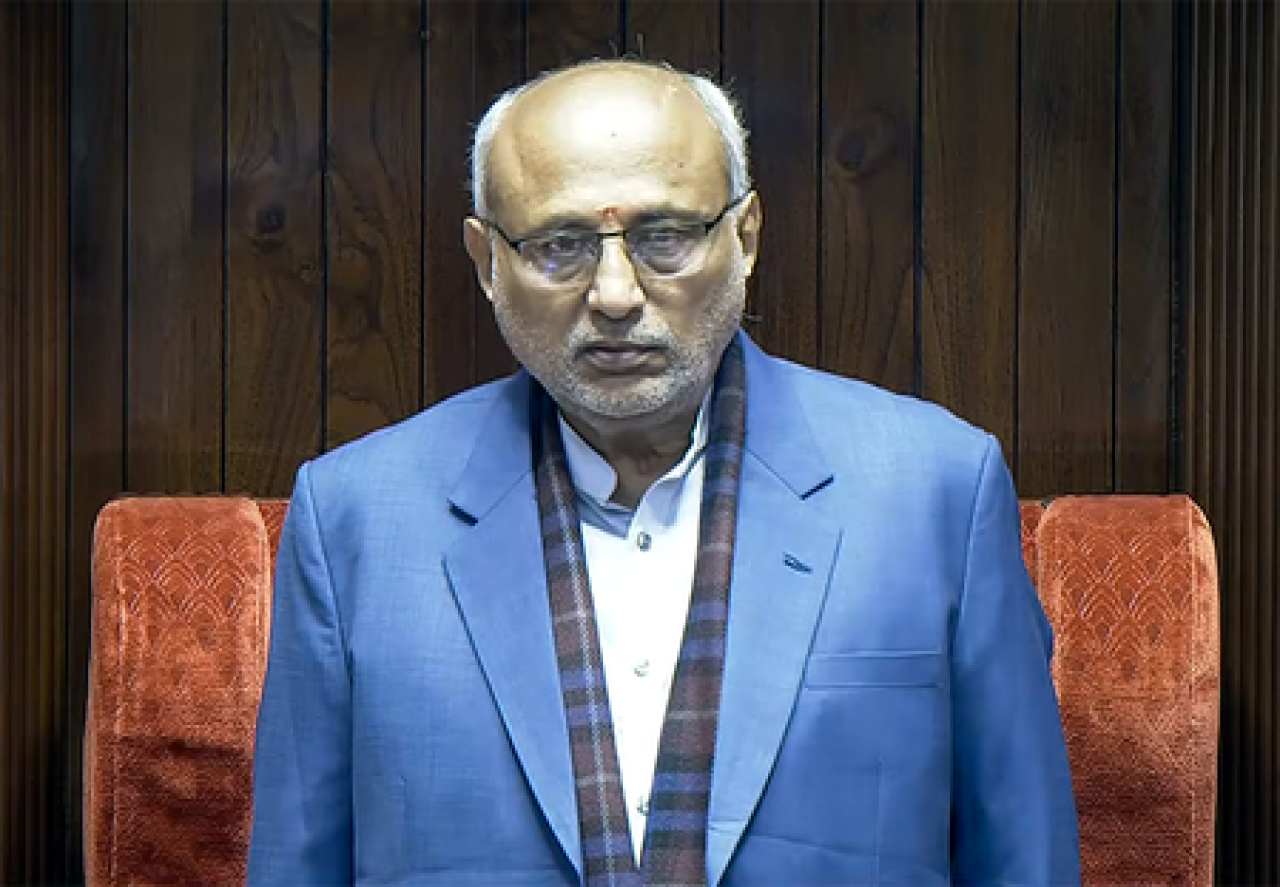

New Delhi, April 14: India’s Vice President C. P. Radhakrishnan extended warm wishes to the Tamil community on the occasion of Tamil New Year, stating that the first day of Chithirai represents a fresh and auspicious beginning not just for Tamils, but for people around the globe.
He emphasized that Tamil New Year is more than a traditional festival; it is a celebration of our ancestors’ wisdom. This festival connects tradition, family, spirituality, and the order of life. It marks the start of new hopes, learning from past experiences, and moving forward. We should celebrate this festival with pride, as it reflects Tamil culture and a scientific outlook.
C. P. Radhakrishnan noted that the month of Chithirai signals the beginning of agricultural preparations. Farmers start to ready the land for cultivation. Our people believe that hard work is the path to progress, and they celebrate this labor as a festival. Such celebrations across the country exemplify India’s unity and harmony.
He pointed out that in North India, people celebrate Baisakhi as a harvest festival, while in the South, Kerala observes Vishu, where the tradition of viewing ‘Kani’ holds significance. In Assam, Bihu is celebrated, and in West Bengal, Pohela Boishakh is marked with great enthusiasm. Similarly, Manipur, Tripura, Odisha, Bihar, Uttar Pradesh, Himachal Pradesh, Haryana, and Rajasthan also observe this day as New Year.
The Vice President mentioned that in Haridwar, Uttarakhand, people gather from all over the country to bathe in the Ganges on this day. Telugu speakers recently celebrated their New Year as Ugadi, while Marathi and Konkani communities observe Gudi Padwa. We are heirs to an ancient civilization that has existed for millennia. The scientific knowledge of our ancestors indicates their profound understanding of the world and its workings.
He explained that it takes approximately 365.25 days for the Earth to orbit the Sun, and this calculation determines our New Year. Thus, the timing of the Tamil calendar is precise and balanced. While it is essential to follow the global calendar, we must also remember our Tamil calendar. The tradition of naming not just days and months but also years is our uniqueness, with a total of 60 year names, the current one being ‘Parabhava,’ which is the fortieth.
He further noted that the term ‘astronomy’ comes from Greek, meaning ‘the science of studying the rules of stars.’ Our ancestors referred to it as ‘Khagol Vigyan.’ They understood thousands of years ago that the Earth is round and studied the movements of planets.
The Vice President highlighted that Sangam literature provides extensive information about planets and stars. For instance, the poet Kapilar described Saturn as ‘black’ in the Puranauru. Our ancestors had a deep understanding of the influence of planets on human life. Those who made such calculations were known as ‘Kaniyan.’ The poet Kaniyan Poongundranar is associated with this tradition. Tolkappiyar referred to such knowledgeable individuals as ‘Arivar.’ Since ancient times, auspicious events like marriages have been conducted based on favorable timings, as described in Agananuru. This tradition continues today.
He stated that the Panchang has five components: ‘Vara, Tithi, Karana, Nakshatra, and Yoga.’ Predictions about rain, agriculture, and prosperity are made based on these. Our ancestors calculated time based on the movements of the Sun and Moon. Today, modern tools are used to calculate eclipses, but our ancestors accurately determined these centuries ago. Is not the knowledge of our ancestors our heritage? Therefore, we must preserve it and pass it on to future generations.
The Vice President noted that due to the significant Tamil population and historical ties in Southeast Asia, Tamil New Year is celebrated with great enthusiasm in Sri Lanka, Malaysia, Singapore, and Mauritius. This festival reminds us of our cultural heritage and demonstrates that New Year is celebrated under different names in various parts of India, symbolizing our unity.

Leave a Comment