
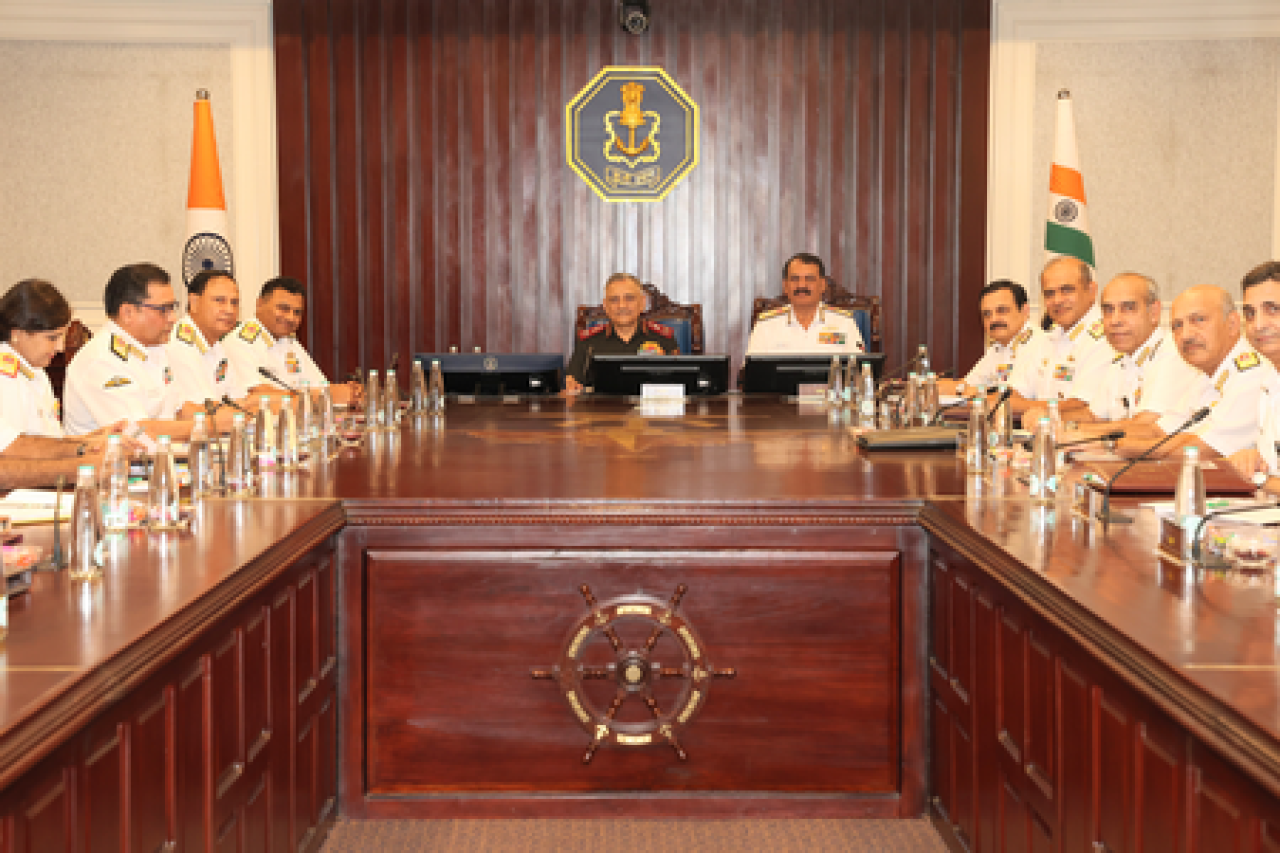

New Delhi, April 15: The Indian Navy has played a vital role in ensuring the safe passage of commercial vessels in the Persian Gulf region. The deployment of naval warships has provided security assurances to Indian sailors and maritime trade. This information was shared by Admiral Dinesh K. Tripathi, the Chief of the Navy.
He highlighted the ongoing instability in West Asia and its serious implications for maritime traffic. According to him, security has become an interconnected reality that is both continuous and stringent. The geographical distance of a conflict does not diminish its impact. Admiral Tripathi also mentioned plans to induct over 15 indigenous platforms into the Navy this year.
Notably, a significant conference for top Indian Navy commanders is currently underway in New Delhi. During this Commanders’ Conference, Admiral Tripathi shed light on the rapidly changing global power dynamics. He noted that the world has transitioned from a phase of competition to one of conflict over the past five years. Modern warfare, he emphasized, is not limited to military actions but also includes economic pressure, technological advancements, and concepts like “narrative warfare.”
The conference, which began on April 14, includes not only the Navy Chief but also the Chief of Defense Staff. Navy commanders are strategizing on maritime security, operational readiness, and national interests in the current global landscape. The top leadership, operational commanders, and senior officials are participating in this crucial event. Admiral Tripathi pointed out the increasing pressures on maritime security, stating that the maritime domain has become extremely complex and challenging. Multiple conflicts, the rising capabilities of adversarial nations, and the weakening role of international institutions are significant factors contributing to this complexity.
Additionally, the easy availability of weapons to non-state actors has further complicated the maritime environment. In this scenario, the Indian Navy operates daily in a competitive and sensitive atmosphere. Admiral Tripathi highlighted the Navy’s achievements, noting a remarkable increase in combat capability over recent years. Continuous modernization has been undertaken across surface, submarine, and air domains. The Navy has developed a robust maintenance system and infrastructure, making it a “combat-ready, reliable, and future-ready” force.
He mentioned that the Navy has utilized 100% of its total budget, completing over 90 capital contracts. The first voyage of INS V. Koundinya, along with multilateral events like the Maritime Mahakumbh, IFR, Milan, and IONS, has further strengthened India’s maritime reputation. Admiral Tripathi also discussed improvements in human resource development, training, medical facilities, welfare, and sports within the Navy.
These initiatives have fostered trust, unity, and morale among personnel. During the Commanders’ Conference, key issues such as joint operations, capability development, maintenance, multi-domain security, training, foreign cooperation, human resources, and indigenization were extensively discussed. Chief of Defense Staff General Anil Chauhan emphasized the need for Navy commanders to adapt to the changing geopolitical landscape and the evolving nature of warfare. In conclusion, Admiral Tripathi clarified that maintaining combat capability at the highest level, developing force structure, logistics and maintenance, integrating new technologies, strengthening human resources, and promoting organizational resilience and unity will define the direction of the Indian Navy.

Leave a Comment