
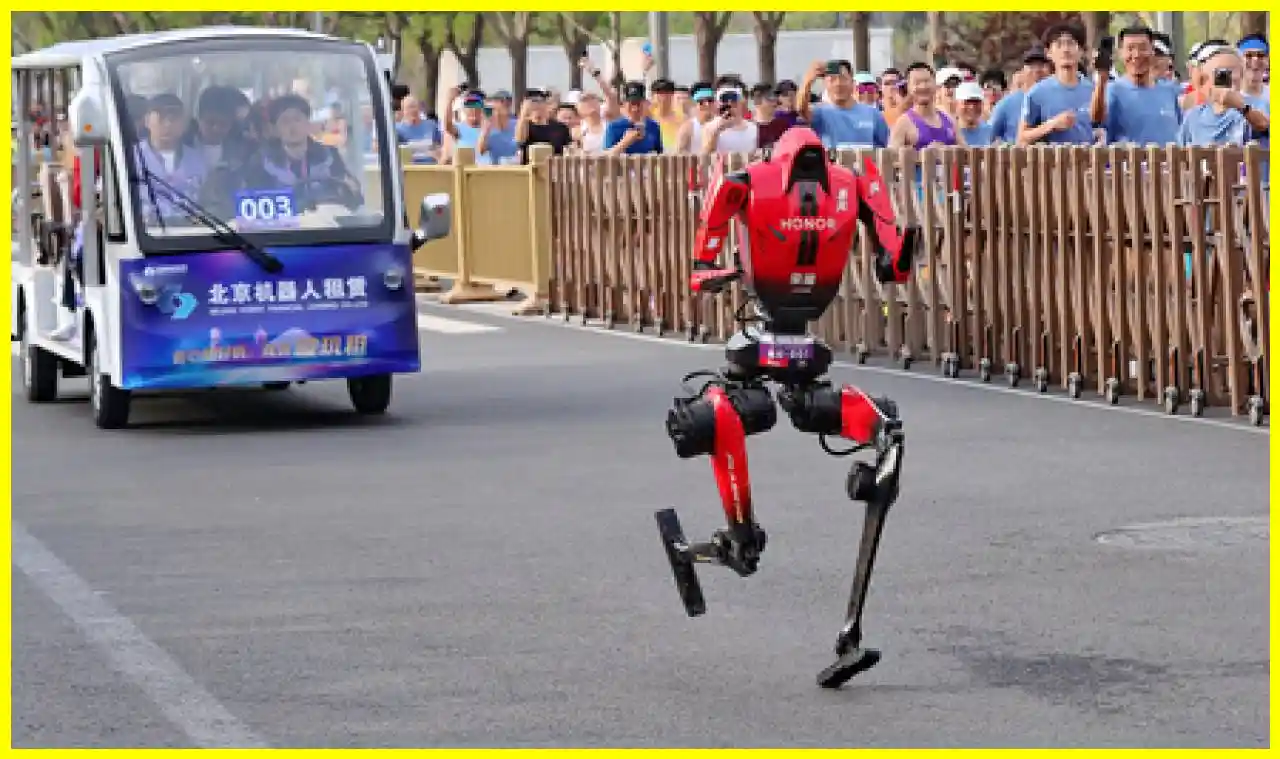
Beijing, April 22: On April 19, 2026, an extraordinary event unfolded at the Yichuang Half Marathon in Beijing. A humanoid robot named “Lightning” completed the 21-kilometer race in just 50 minutes and 26 seconds. This remarkable feat not only set a new world record for robots but also surpassed the human record for the men’s half marathon. The news spread rapidly, with some celebrating it as a significant leap in technology, while others pondered the implications of a machine outpacing humans.
Humans rely on their hearts, lungs, muscles, and evolutionary capabilities developed over millions of years to run 21 kilometers. In contrast, “Lightning” depends on batteries, motors, algorithms, and lightweight materials. With each step, it calculates how to land, how much force to exert, and how to conserve energy. Its victory was not achieved through running but through computation. This is not merely a machine taking the place of humans; rather, in a specific task, an engineering system outperforms a biological one.
While this achievement is undoubtedly impressive, it is crucial to understand the context behind it. First, the competition took place under optimal conditions: a smooth road, favorable weather, and the presence of a technical team throughout the process. Had the race been in a hilly area, during rainy weather, or if the machine had encountered a malfunction, the outcome could have been entirely different. Second, the standards for “competition” differ between humans and machines.
Strict rules and certifications govern human world records, but there is currently a lack of unified standards in robot competitions. Different machines use various batteries, motors, and algorithms; thus, this type of “competition” resembles a technology demonstration more than a sporting event. More importantly, a machine’s speed does not necessarily mean it is “better” than a human. The essence of a marathon lies not in speed but in the determination of the individual who continues to run despite exhaustion, pain, and the urge to quit. Robots do not challenge themselves nor do they experience pain.
The rise of “Lightning” prompts us to shift the discussion from “how machines will replace humans” to “how humans and machines will work together in the future.” High-performance robots will be invaluable in areas where human access is challenging, such as disaster relief, hazardous environments, and military reconnaissance. In sports, we can see a clear division: the human field is for the human body, emotions, and willpower; the robot track becomes a testing ground for technological innovation.
The achievement of “Lightning” at the Yichuang Half Marathon marks not the end of human athletics but the beginning of a new chapter. It reminds us that as machines become more human-like, we must ask ourselves—what aspect of humanity cannot be replaced? The answer may not lie in the speed of running but in the heartbeat that resonates with every step taken across the finish line.
(Source: China Media Group, Beijing)




Leave a Comment